


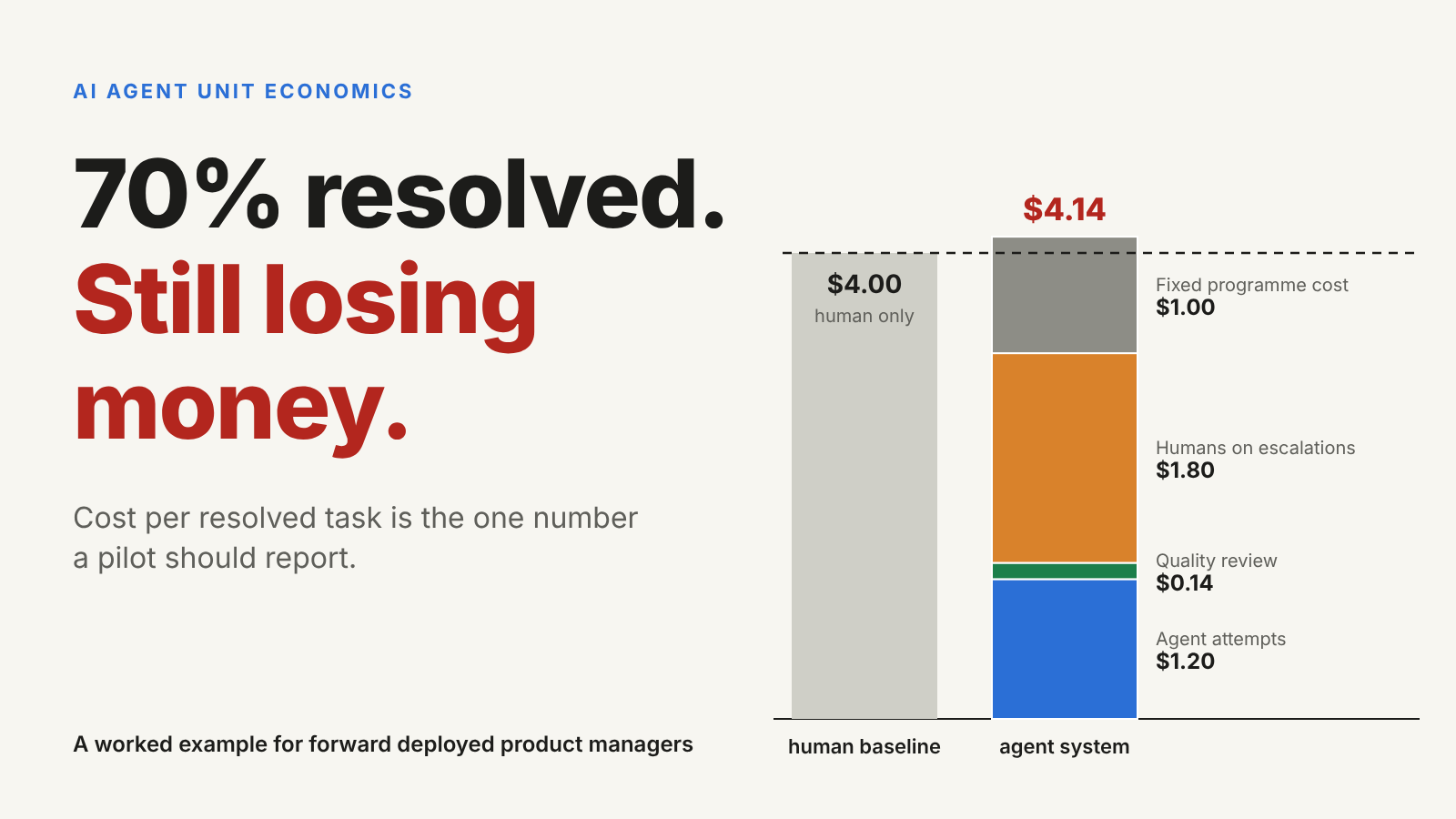
An Agentic AI pilot project that reports cost per token or cost per conversation can look cheap and still lose money on every customer it serves. The number that settles the question is the fully loaded cost per resolved task, set against what the same task costs a human today.
The story: an AI assistant that "does the work of 700 people", and what the headline left out
In February 2024, Klarna announced that its AI assistant had handled 2.3 million conversations in its first month, about two-thirds of its customer-service chats, and was doing the work of 700 full-time agents. It reported that resolution time fell from 11 minutes to 2, and it estimated a $40 million profit improvement after freezing non-engineer hiring in December 2023.
Look at what those numbers measure: volume, speed and headcount equivalence. They are real signals. None of them is the cost of a task that was resolved well.
By May 2025 the tone had changed. Klarna’s CEO told Bloomberg that cost had been “a too predominant evaluation factor”, which led to lower quality, and the company began hiring human agents again so customers could always reach a person. Klarna disputes the idea that it is retreating from AI. It told CMSWire that the bot’s workload keeps growing and that humans now take the higher-end conversations.
I cannot see Klarna’s books, so I am not claiming its accounting was wrong. The lesson is in the shape of the story. The cheap, visible part (conversations handled) was reported loudly. The expensive part (conversations that needed quality, rework or a human) surfaced later, in customer experience.
The lesson: measure what the customer paid for
A customer does not buy tokens, conversations or “AI”. They buy a fix for their problem. So, the fairest unit to measure is a problem that is actually solved. We call that a resolved task.
Cost per token is the price of one ingredient. Cost per conversation is the price of one try. Cost per resolved task is the price of the finished solution.
The Klarna story shows why this matters. Tries are cheap and easy to count. Results are costly and slow to show up. If you only count tries, you reward people for starting work, not for finishing it. Failures, retries and handoffs never get counted, because their costs sit in other budgets: the support team, the review queue, and customers who leave.
To see the real picture, add up all the money the system uses, including what humans spend fixing its failures. Then divide that by the number of tasks that truly ended resolved:
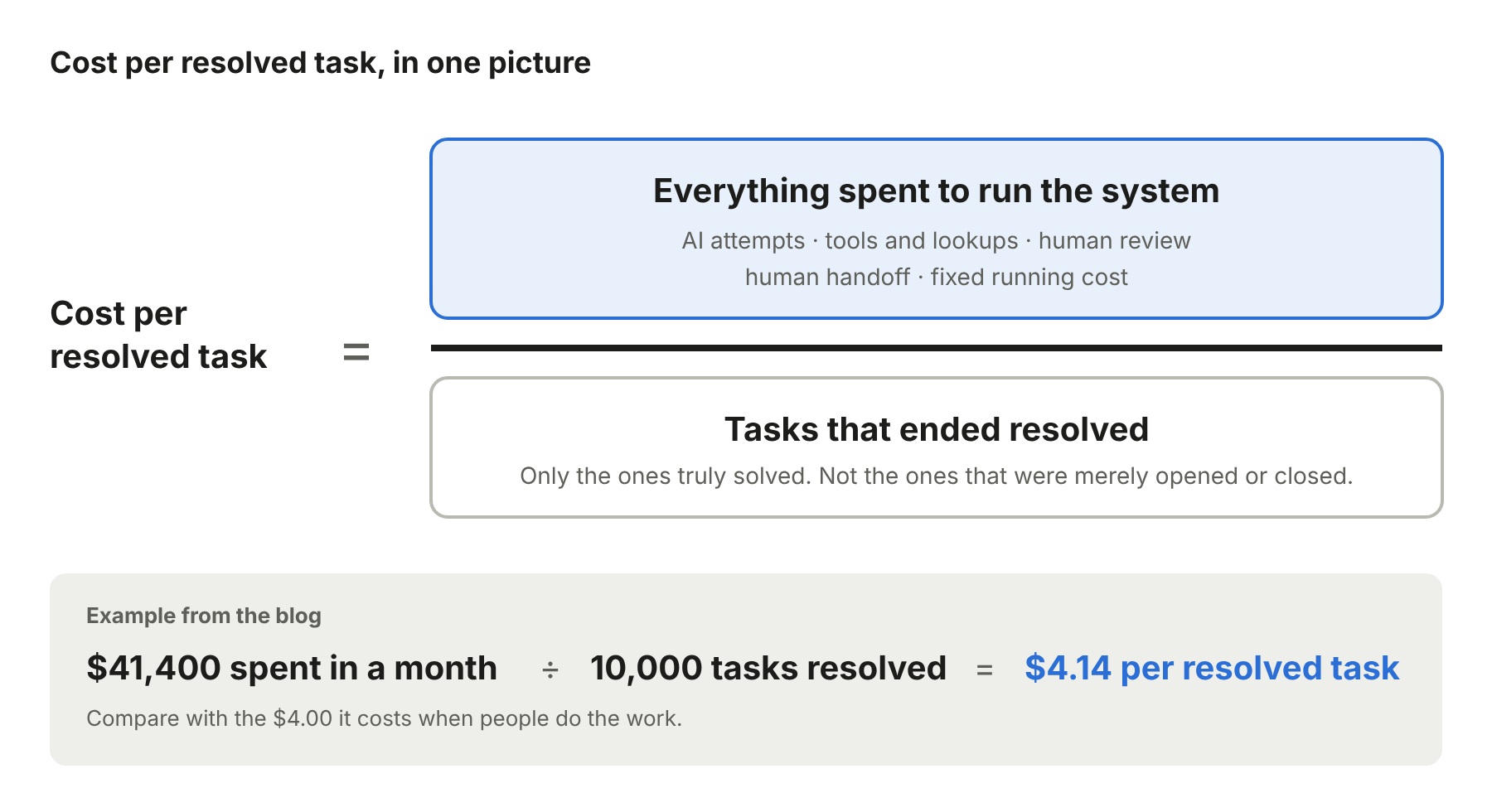
Take every dollar you spent running the system in a month, and divide it by the number of tasks that were truly solved.
Top part: everything spent to run the system. This is the whole bill, not only the AI’s share:
The AI’s attempts on every task, including retries
Tool and lookup costs
Human checks on a sample of the AI’s answers
People’s time on tasks the AI could not solve
The fixed running cost: the people who look after the system, on-call duty and licences
Bottom part: tasks that ended resolved. Count only tasks that were really solved, whether by the AI or by a person after a handoff. A task that was opened, closed and came back angry does not count.
Why it is necessary
A deployment makes money only if the cost of reaching an outcome is lower than the cost it replaces. Four things follow, and each one is invisible to cost per token.
Pilots make things look cheaper than they are. A pilot has few tasks, hand-picked ones, and often free credits and engineers who help at no cost. At full scale the real costs show up: retries, long conversations, review queues and keeping the content up to date.
An average can hide a few very costly tasks. A small number of tasks can get stuck, retry and call tools again and again. They use up a big part of the budget, while the average still looks fine.
A failure costs you twice. When the AI can’t finish a task, you pay for its failed try, and then you pay for a human to take over. That person usually needs more time than usual, because the customer is already upset and some details get lost in the handoff.
Resolution rate and cost go hand in hand. When the AI finishes more tasks, fewer tasks go to expensive humans, so the cost per resolved task goes down. Cost per token cannot show this, because it only counts what the AI itself spends.
This number also helps you make decisions. It helps you set the price in the contract. It shows which kinds of tasks to automate first. It tells you whether a cheaper AI model really saves money or just looks cheaper. And it gives the customer’s finance lead something solid to approve. Without it, the choice to go from pilot to full rollout is based on excitement, not facts.
Now flip the question around. What would I do if I wanted a pilot to look great and then fall apart at scale? I would report the cheapest number, test only the easy tasks, and hide the human costs in someone else’s budget. If your pilot report looks like that, you have already set it up to fail.
How to do it properly
Write down what “resolved” means for each type of task. A finished conversation is not a solved problem. Agree on a test with the customer: the problem does not come back within an agreed time (for example, 7 days), a sample check shows the answer or action followed the rules, and something real actually changed (the refund was paid, the address was updated). If a task fails this test, count it as unresolved, even if the customer never complained.
List every cost a task creates. Six lines cover most of it:
AI model calls: every call for the task, including retries, failed checks and very long inputs.
Tool and lookup calls: APIs, search, the vector database, and any paid data source.
Platform: hosting, tracing, and the test runs that keep quality in check.
Human review: spot checks and approvals on tasks the AI finished.
Handoff to humans: the time people spend on tasks the AI could not solve. Track this on its own, because it usually takes longer than a normal task.
Fixed running cost: on-call time, the people who look after prompts and content, and licences. Share this cost across all tasks.
Track cost per task, not per call. Tag every model call, tool call and human touch with a task ID, then add them up by task. A tracing tool such as Langfuse can group calls this way. This shows you how costs are spread, and which few tasks cost the most.
Be fair when you work out the human cost. Use the full cost of the people who do this task today: pay, overhead, tools and management, divided by the hours they really work, multiplied by the real time each task takes, including redoing work. Compare against that, not against the cheapest outsourcer or a company-wide average.
Work out the result, then find the break-even point. Show the cost per resolved task for each task type, next to the human cost. Also show the resolution rate where the two costs are equal. This tells the customer how much improvement they are really paying for.
Then apply inversion before you present. Ask: how could this number flatter us? The tree in the next section lists the usual answers, and your job is to check each one.
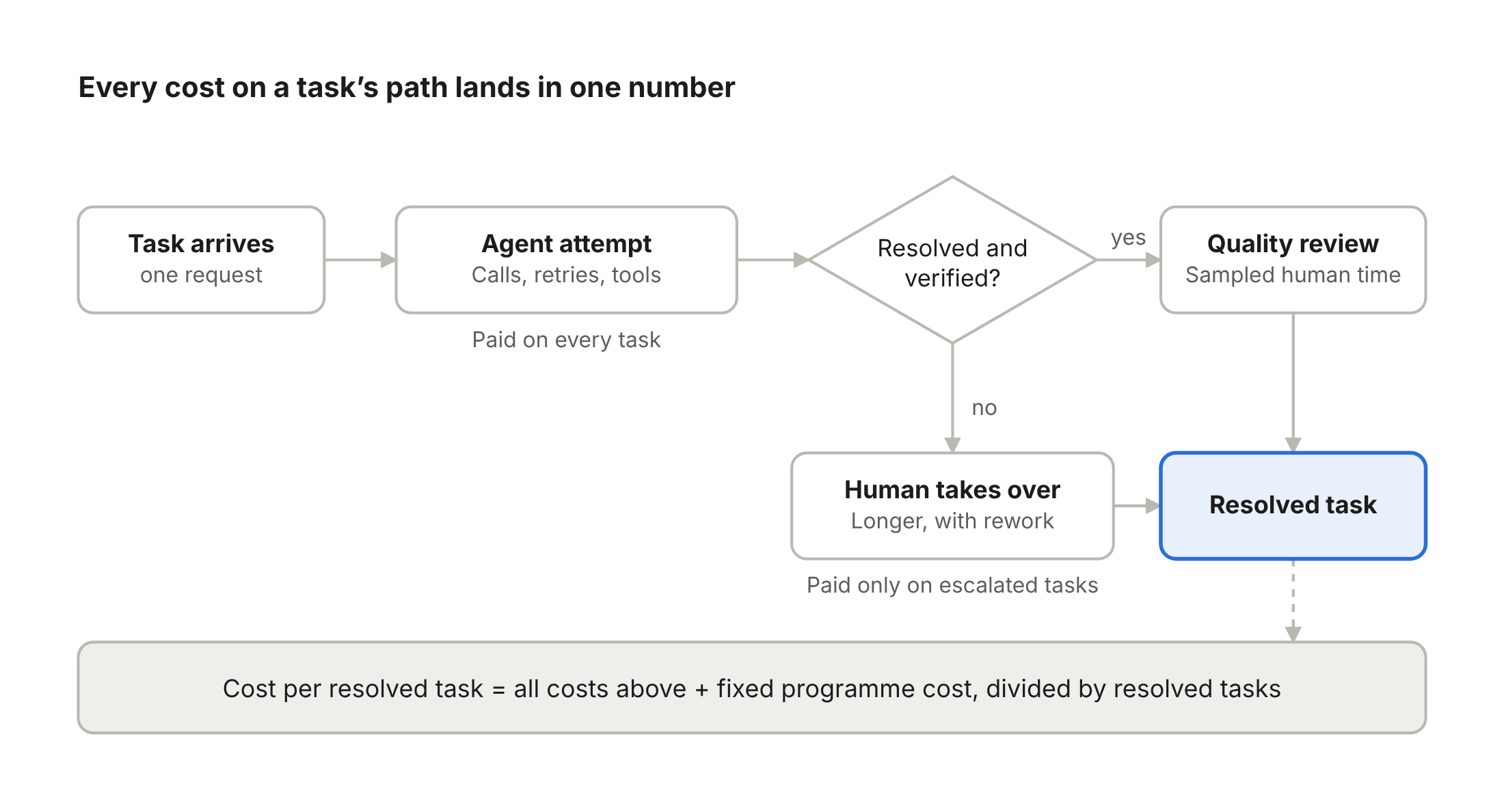
If the AI solves the task, we spend a little more to check a small sample of its answers.
If the AI cannot solve it, a person takes over. This costs more, because it usually takes them longer.
In the end, every task is solved, either by the AI or by a person. The bottom band shows the final number. We add up all the money spent on every task, add the fixed running cost, and divide by the number of tasks that were solved. Nothing is left out, so the number is honest.
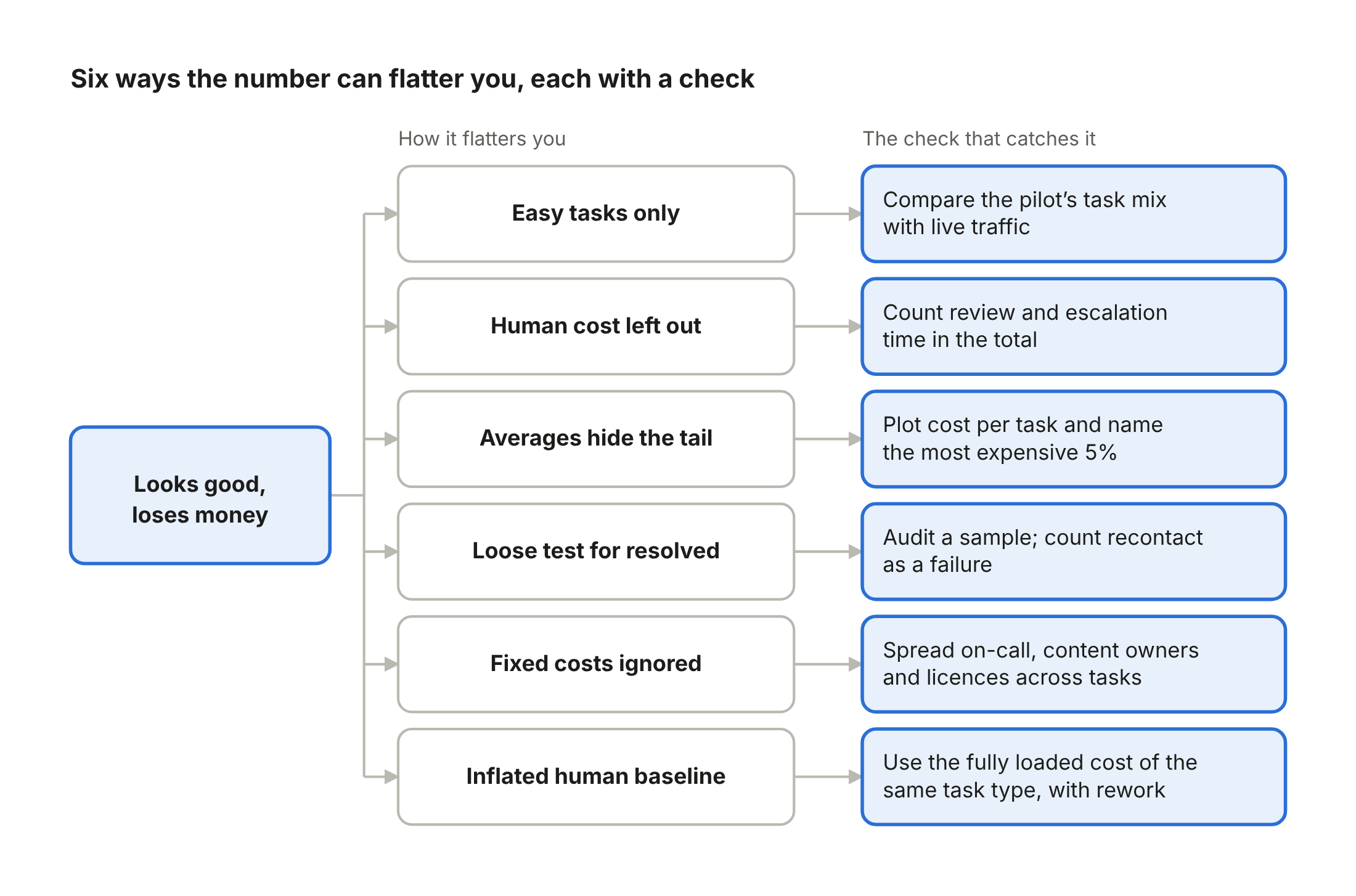
The inversion tree: 6 ways the number can fool you, and how to check each one
Inversion means starting from the result you do not want and working backwards. Here, the result we fear is a pilot that looks great on paper while the business loses money.
The tree shows six things that can cause this. Next to each one is a simple check. Run all six checks before you show the number to the steering committee.
The cost model
A 70% resolution rate sounds like a win. But in the example below, it still loses $1,400 every month.
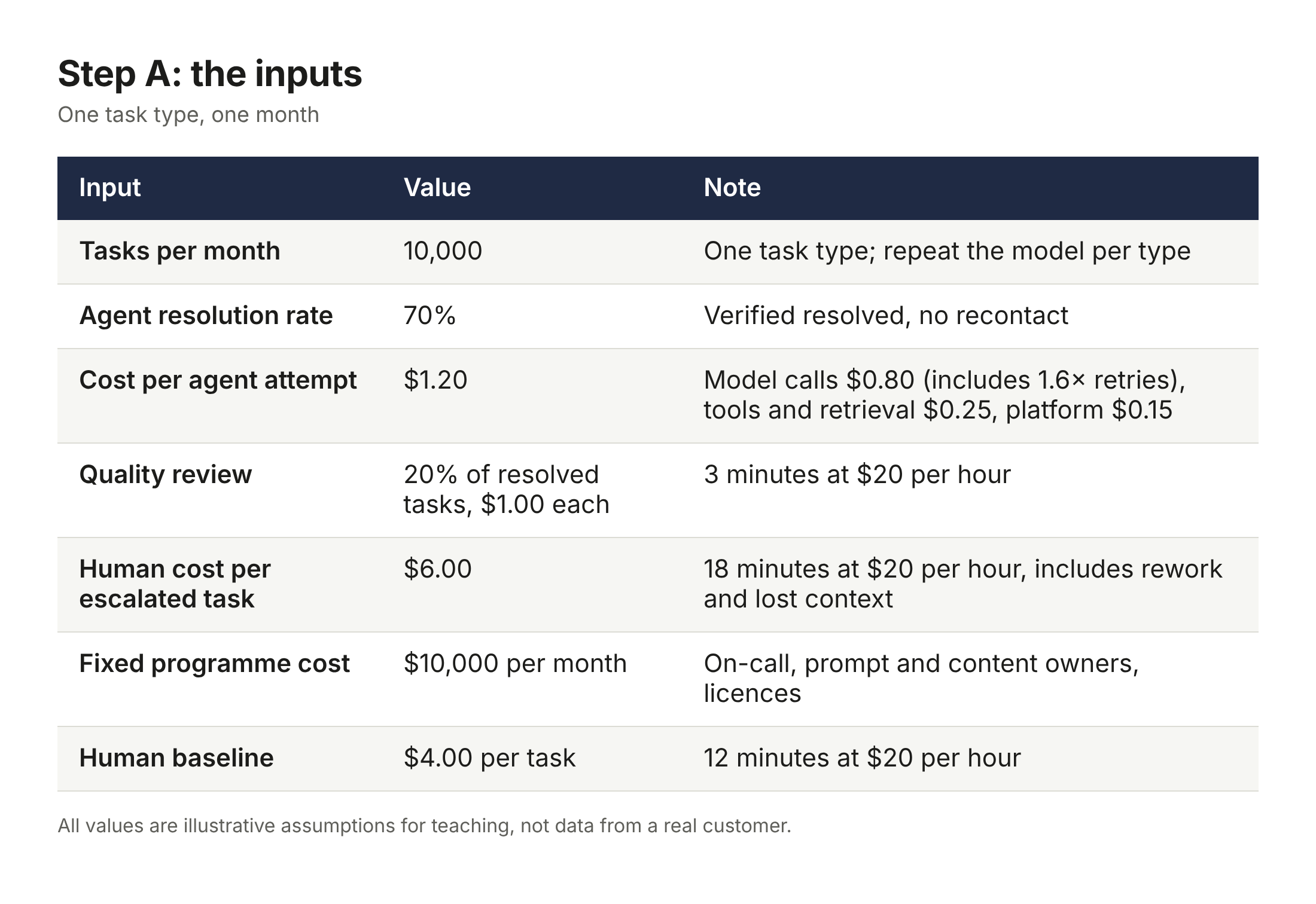
The numbers in this example are made up to teach the idea. They are not from a real customer. When you use this in a real project, replace them with your pilot project’s own numbers.
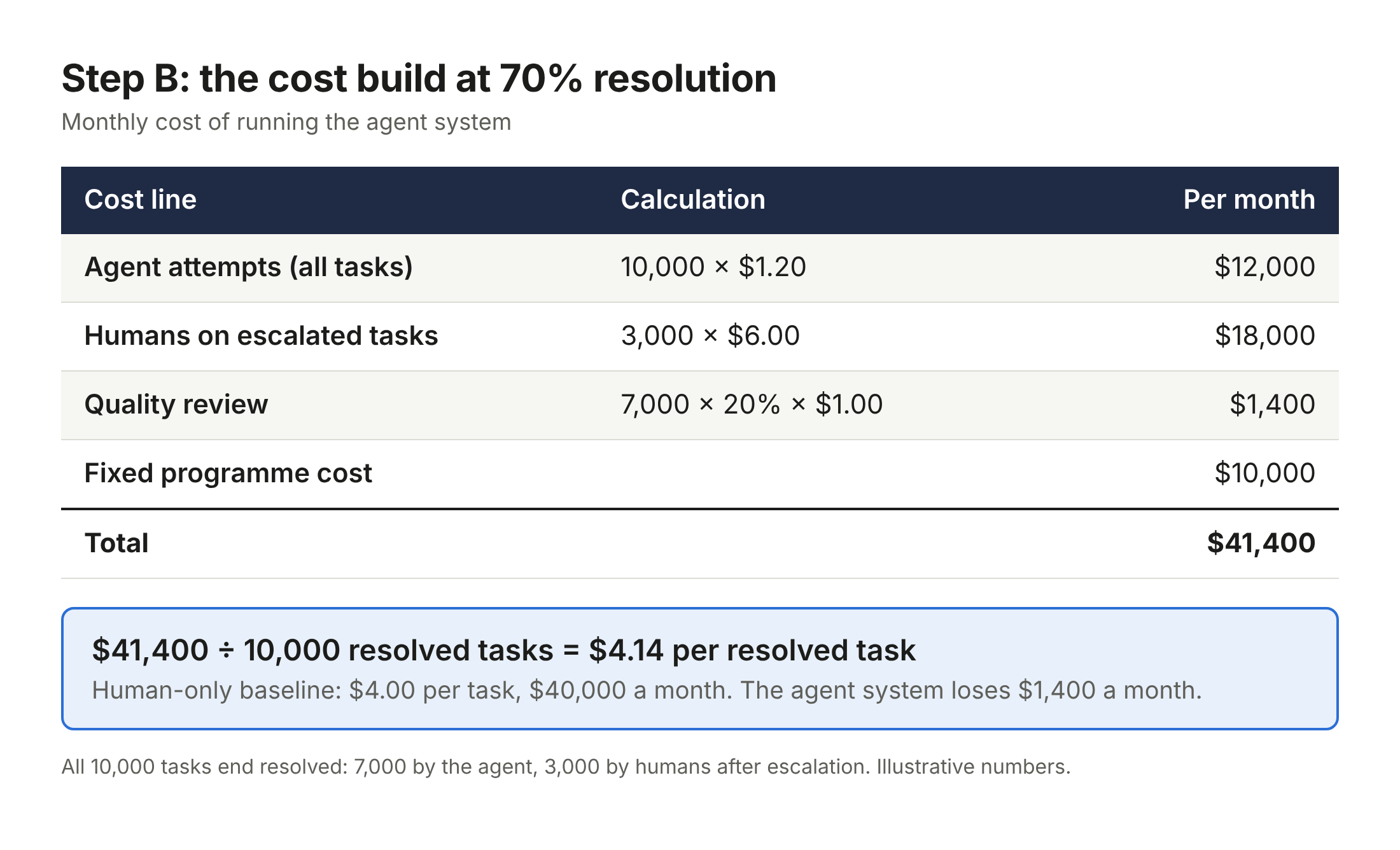
All 10,000 tasks end resolved, 7,000 by the agent and 3,000 by humans, so the cost per resolved task is $41,400 / 10,000 = $4.14. The human-only baseline is $4.00, or $40,000 a month. The agent system loses $1,400 a month at 70% resolution.
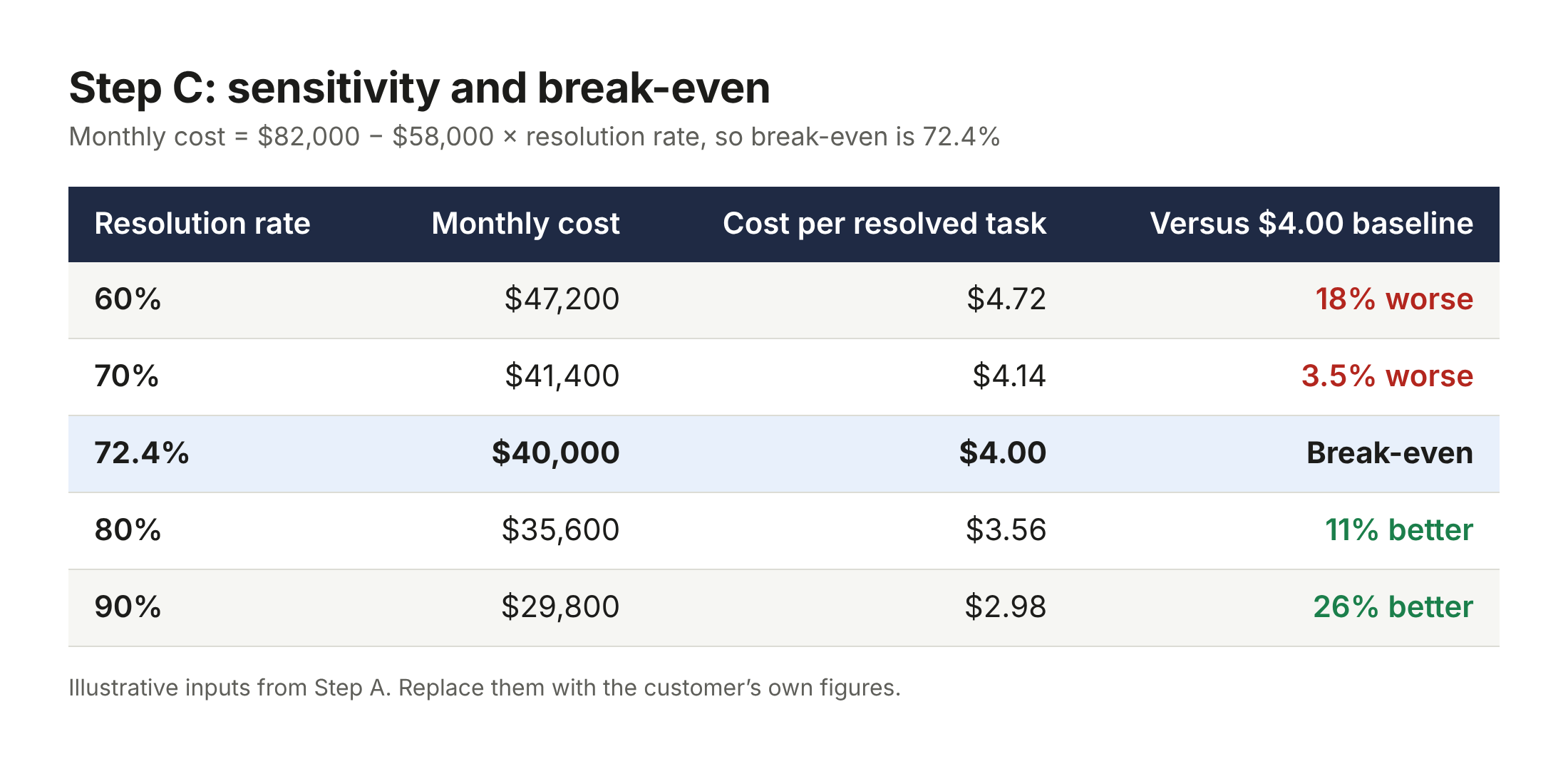
With these numbers, the monthly cost of using the AI is $82,000 minus $58,000 for every unit of resolution rate. In plain terms: the more tasks the AI solves, the lower the bill.
Maths behind $82,000 and $58,000
Agent solves nothing:
AI attempts on every task: $12,000
People handling all 10,000 tasks: $60,000
Fixed running cost: $10,000
Total: $82,000
Agent solves everything :
You save the handoff cost. No person has to take over, so you save $6.00
You add a quality check on 20% of solved tasks, which costs about $0.20 per solved task (20% × $1.00).
So each extra solved task saves $6.00 − $0.20 = $5.80.
Now do it for all tasks. There are 10,000 tasks a month. If the AI solved all of them, you would save $5.80 × 10,000 = $58,000.
The human-only option costs $40,000 a month. The AI becomes cheaper only when it solves at least 72.4% of tasks. Below that, the AI costs more than people. This is the break-even point.
Find the cheaper lever
Two cheaper moves change the answer at the same 70%.
• Cut retries from 1.6 times to 1.2 times. Attempt cost falls to $1.00, the total to $39,400, and the cost per resolved task to $3.94. The pilot now beats the baseline.
• Redesign the handoff so humans take 15 minutes, not 18. Escalation cost falls to $5.00, the total to $38,400, and the cost per resolved task to $3.84.
What to put in the pilot report
• The written definition of resolved, and how it was audited.
• Cost per resolved task by task type, next to the human baseline.
• The break-even resolution rate and where the pilot sits against it.
• The cost-per-task distribution, with the expensive tail named.
• The sensitivity table, so the customer sees which lever matters most.
Where the inputs come from
None of the seven input values comes from a report. They are round, illustrative numbers chosen so the example shows the break-even effect. Replace each one with your own figures. The published figures below show where they sit.
Human cost per task ($4.00): This is lower than most published figures. A 2019 Gartner poll found an average of $8.01 per contact on live channels. A later Gartner benchmark gives a median of $13.50 for assisted support. Both are about customer service in general, not AI work. Use your own cost per ticket.
Time per task (12 and 18 minutes): These are in the normal range. Zendesk says about 6 minutes is a good average. One benchmark compilation gives 6 to 10 minutes for routine phone calls and 18 to 30 minutes for escalated ones.
$20 an hour for a person: This is my own assumption, with no source. Get the real figure from the project’s finance team: pay plus overheads, divided by the hours people really work.
Cost per AI attempt ($1.20): No source. Measure it from your own traces. For a market reference, Intercom’s Fin charges $0.99 per resolution. One compilation puts AI support at $0.99 to $1.50 per resolution, against $10 to $15 when a human handles it. These are prices that customers pay, not what the vendors spend.
Resolution rate (70%): This is an assumption, chosen close to the break-even point. In a real project, measure it with a strict test. Vendors can define “resolved” more loosely. For example, Intercom counts a task as resolved when the customer asks for no more help after the last AI answer.
Quality review (20% of tasks, $1.00 each) and fixed cost ($10,000 a month): These are design choices and assumptions. Build the fixed cost from a list of named items: people’s time, on-call duty and licences.
Tasks per month (10,000): Use the real ticket counts.
Sources
Klarna case study, pages opened via search on 24 November 2026. The worked example’s numbers are illustrative, not from any source.
• TechRadar: Klarna’s AI assistant, first-month volume and the 700-agent equivalence
• Gigazine: resolution time and the rehiring of human agents
• eMarketer: Klarna backtracks, the $40 million estimate and the CEO’s comment on cost
• Entrepreneur: Klarna hiring customer service agents again
• CMSWire: Klarna’s response that it is giving AI more work, not less
• Gartner 2019 press release: cost per contact by channel
• Gartner benchmark abstract: median cost per contact
• Intercom: Fin resolution pricing and definition
• Sacra: per-resolution pricing across the AI support category (secondary)