


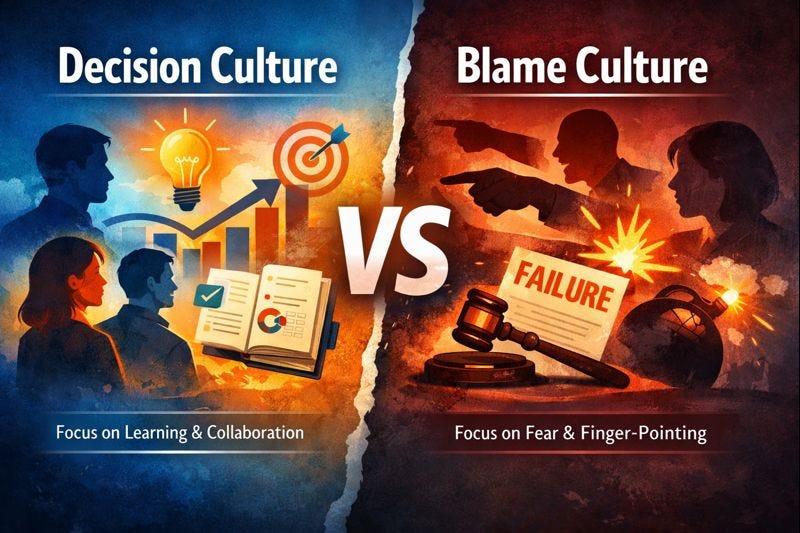
Most workplaces say they want “accountability.” But what many teams actually experience is something else: blame. And the difference is not semantic. It changes how people speak in meetings, how fast decisions get made, how risks are taken, and whether the organization learns—or repeats the same mistakes with new names attached.
A decision culture is a workplace where people are rewarded for making clear, timely decisions and for learning from outcomes—good or bad. A blame culture is a workplace where people are judged mainly by outcomes, especially negative ones, and where the primary goal becomes self-protection. In a blame culture, people don’t avoid bad decisions; they avoid being seen as the person behind a decision that might go bad.
Here’s the uncomfortable truth: most blame culture is not built by “bad employees.” It’s built by normal leaders responding to pressure. When deadlines slip, customers complain, or executives ask “How did this happen?”, leaders often default to finding a person to attach the event to. It feels like control. It feels like accountability. But it trains the organization to hide uncertainty, avoid ownership, and escalate everything upward.
To understand why this happens, you need to understand outcome bias. Humans naturally judge decisions by results. If a risky decision works, we call it bold. If the exact same decision fails, we call it reckless. Research has shown that outcomes strongly influence how people evaluate decision quality, even when they are told to ignore the outcome and focus only on what was known at decision time. This bias is a root cause of blame culture. It creates “retroactive intelligence”—the illusion that the right answer was obvious after the fact.
You can see this in everyday office life. Imagine a product manager ships a feature based on customer feedback and early data. If adoption is strong, the PM is “customer-obsessed.” If adoption is weak, the PM “didn’t think it through.” The inputs may have been the same. What changed was the outcome—and the story people tell about the decision.
Blame culture shows up in small phrases. “Who approved this?” “Why didn’t you catch it?” “This is unacceptable.” These lines sound like standards, but they often come without curiosity. The team quickly learns a simple rule: when things go wrong, speaking up makes you a target. So, people stop speaking up. Or they speak up in private only. Or they fill meetings with polite agreement and then quietly hope someone else takes the hit.
Over time, three predictable behaviors appear. First, people delay decisions until they feel “safe,” which often means until the deadline forces a rushed choice. Second, people escalate decisions upward so they can share or transfer risk: “Let’s get leadership sign-off.” Third, people document after the fact to defend themselves: long emails, long meeting notes, long trails of “as discussed.” The organization becomes slower, heavier, and more political—but leaders interpret that as “more diligence.”
A decision culture looks different, and the key difference is subtle: it separates judgment of the decision process from judgment of the outcome. That doesn’t mean outcomes don’t matter. Outcomes always matter. It means the organization learns to ask two different questions. First: “Was this a high-quality decision given what we knew at the time?” Second: “What did the outcome teach us that we didn’t know?” When these questions are normal, people don’t have to pretend certainty. They can make responsible bets, learn fast, and get better.
This is where psychological safety becomes central. Psychological safety is not about being “nice.” It’s the shared belief that it’s safe to speak up, ask questions, admit mistakes, and surface risks. Amy Edmondson’s research on psychological safety and team learning showed that when people fear interpersonal consequences, they hide errors and avoid learning behaviors; when they feel safe, teams discuss problems earlier and learn faster. In plain language: people will only tell you the truth if the environment doesn’t punish them for it.
Now, many leaders push back here and say, “If we remove blame, people won’t be accountable.” This is where the concept of just culture is helpful. Just culture is often used in safety-critical industries like healthcare and aviation. Its basic idea is balance: encourage reporting and learning, while still drawing a clear line for negligence, recklessness, or intentional harm. In healthcare literature, a just culture is described as shifting focus away from simply blaming errors and outcomes and toward improving systems and managing behavioral choices in a fair way. In other words, it’s not “no accountability.” It’s better accountability—based on intent, context, and system design, not just the pain of the outcome.
You can use a relatable example to see the difference. Suppose a customer support lead follows the correct process, but the customer still churns because the product lacked a critical feature. In blame culture, the question becomes “Why did you fail to retain them?” In decision culture, the question becomes “What did the customer teach us about our product gap, and how do we feed that learning into prioritization?” The support lead is not treated as the culprit for a product reality. The organization learns instead of scapegoats.
Another example: a security incident happens because a team reused an old access pattern that was once acceptable but is now risky at scale. In blame culture, the organization hunts for the person who “allowed” it. People respond by hiding incidents or minimizing them. In decision culture, the organization asks: “What conditions made this likely? Where did our controls lag behind growth? What decision rules should change?” That approach increases safety because it increases truth-telling.
This is why blame culture is expensive. It produces hidden costs that don’t show up neatly in dashboards. It reduces early warnings, because people stop raising concerns. It increases decision latency, because nobody wants to be the first mover. It creates “approval addiction,” because shared blame feels safer than owned decisions. And it kills innovation, because innovation requires reversible bets, fast feedback, and honest post-mortems—exactly the things blame culture discourages.
So how do you build decision culture in a way that’s real, not performative? You need three things: a simple framework, a practical playbook, and a few reliable metrics to confirm you’re heading in the right direction.
Start with a framework that changes what the team pays attention to. When a decision is made, ask: Who is the owner? What was the context at the time? What assumptions were we making? How will we evaluate the decision later? This is not paperwork for its own sake. It’s a way to prevent memory from being rewritten by outcomes. It also creates fairness: people know they won’t be judged by hindsight alone.
Then apply a playbook that reduces ambiguity. For meaningful decisions, name one decision owner. Capture a short “decision note” before execution: what you chose, what you considered, what you assumed, and what risks you accepted. Keep it brief; if it becomes long, it often signals fear, politics, or lack of clarity. After the outcome, run an outcome-independent review: not “who messed up,” but “what surprised us” and “what would we do next time.” Feed those lessons into the next decision so learning compounds.
Finally, look for metrics. Not vanity KPIs—behavior shifts. In a healthier decision culture, you will see more risks raised earlier, not later. You will see fewer escalations “just in case.” You will see decision notes being referenced in future discussions (“Last time we assumed X; we learned Y”). You will see leaders asking better questions instead of delivering verdicts. Most importantly, after something goes wrong, you will see curiosity first, not courtroom language.
If those signals don’t appear, you may have created a new ritual, not a new culture. A decision log that nobody reads is not a decision culture. A post-mortem that still starts with “who approved this?” is still blame culture wearing a new suit. Culture is revealed in the moments after failure—because that’s when fear is highest and habits are most visible.
Decision culture does not promise perfect outcomes. No mature leader believes that. What it promises is something more valuable: faster learning, better judgment, and an organization that can take intelligent risks without breaking trust. The goal is not to eliminate mistakes; it’s to make mistakes informative, bounded, and less likely to repeat.
Blame culture feels like accountability because it produces a clear villain and a quick sense of closure. Decision culture feels harder because it requires leaders to tolerate uncertainty and to lead with questions. But decision culture is what scales—because it turns every outcome into better decision-making, and it keeps truth alive inside the system.
If you want a single sentence to carry forward, it’s this: blame culture optimizes for self-protection; decision culture optimizes for learning. And in modern organizations, learning speed is strategy.
References:
Research on psychological safety and team learning by Amy Edmondson shows how fear reduces speaking up and learning behaviors.
Research on outcome bias by Jonathan Baron and John C. Hershey shows that people judge the same decision differently depending on outcomes, fueling unfair hindsight blame.
Work on “just culture” in healthcare explains how organizations can balance openness and learning with fair accountability, rather than punishment-driven blame.
Spot on. This deeply ressonates, especially the outcome bias.