


Special thanks to my colleagues Priyanka, Madhavi and Abhijeet in working with me and adding their valuable experience to come up with this framework.
Smart teams rarely fail because they lack intelligence. They fail because they solve the wrong problem precisely. A sprint slips, engineers ask for clarifications mid-development, or a production issue repeats. The response is immediate: add a checklist, tighten documentation, schedule another sync. Something changes, but the pattern returns. This is what we call the Diagnosis Drift — when teams quietly move from observable pattern to confident explanation without structural validation. In high-velocity environments, especially with AI-assisted execution, Diagnosis Drift compounds. The faster you move, the faster you institutionalize the wrong fix.
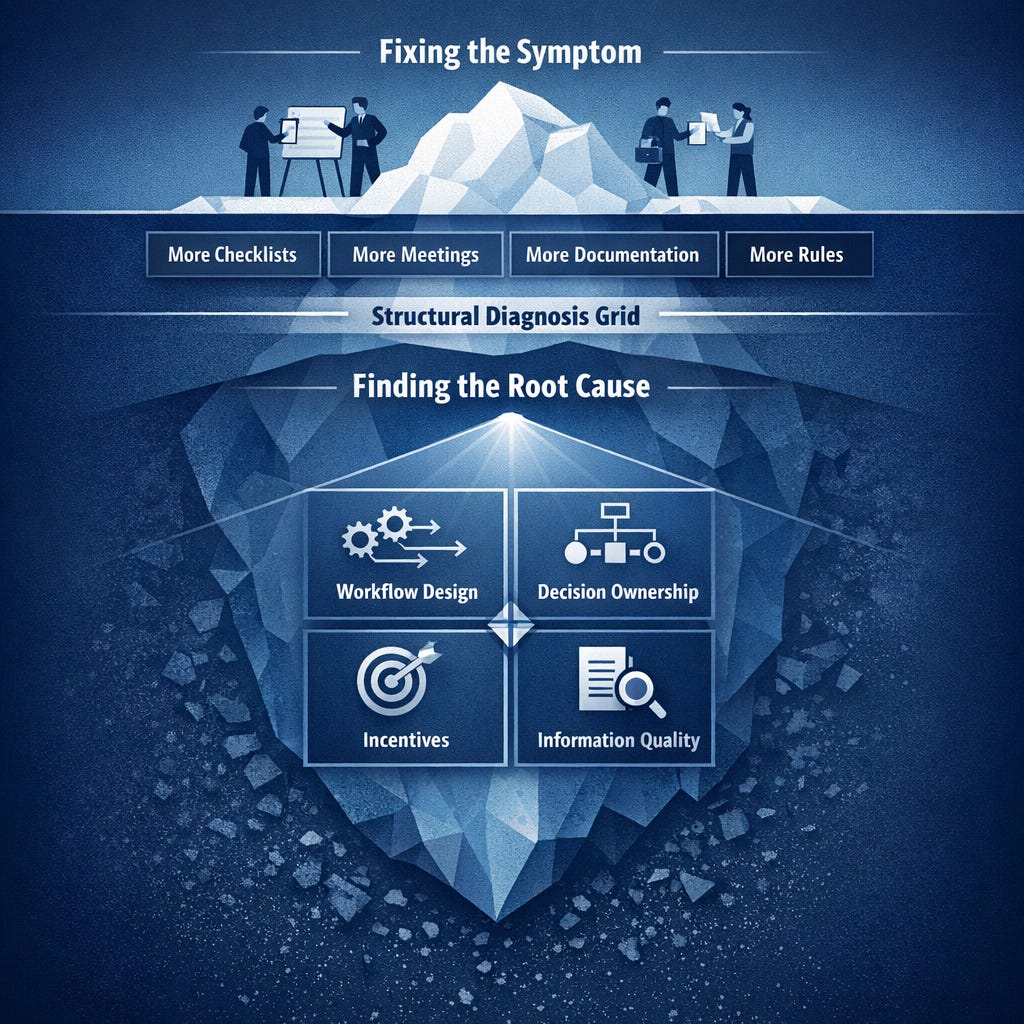
What most teams lack is not problem-solving skill but diagnostic infrastructure. At Arcaence, we use a simple discipline called the Structural Diagnosis Grid. Before acting, we force four gates: describe what is happening (not why), confirm it is recurring (not loud), translate it into measurable impact (not frustration), and examine it through four structural lenses — workflow design, decision ownership, incentive signals, and information quality. This grid exists for one reason: to prevent interpretation from outrunning architecture. Most blame culture begins not with bad intent, but with skipped diagnosis.
Take the familiar complaint: “Requirements are unclear.” That is a conclusion disguised as a problem. Run it through the Grid and the shape changes. Across three sprints, six stories required mid-sprint clarification, leading to rework and delivery volatility. Stories were drafted hours before refinement, readiness ownership was ambiguous, speed was praised over depth, and context was thin. The issue is not documentation quality. It is throughput bias embedded in workflow and decision design. The alignment sentence becomes sharper: We are seeing recurring mid-sprint clarification because refinement optimizes backlog velocity over shared understanding, which produces rework and unpredictability — so we must redesign the system, not correct the people.
This is why diagnosis is cognitive infrastructure. Execution capability has scaled dramatically; diagnosis capability has not. In AI-native organizations, misdiagnosis is no longer a minor inefficiency — it is a structural risk multiplier. Teams that treat clarity as a ritual produce noise. Teams that treat diagnosis as infrastructure produce stability. Before you add another rule, meeting, or escalation path, pause. Run the issue through the Grid. In modern organizations, clarity is not a soft skill. It is system design.
FRAMEWORK STEPS
Step 1: Identify the Problem (What is happening?)
Goal: Capture the pain as an observable pattern—no theories yet.
How to write it well
Use concrete, behavior-based language: “People bypass X” not “People don’t care.”
Describe the moment it happens: during refinement, during handoffs, during deployment, etc.
Keep it neutral (no blame words like lazy, careless, irresponsible).
Good signals
You can point to examples without debate.
Two different people describe the same thing similarly.
Output example
“Team members bypass the golden rule process during urgent changes and ship without the required checklist.”
Rule: Describe what is happening, not why
Step 2: Is this recurring?
Goal: Verify it’s a real systemic issue, not a one-time anomaly.
How to test recurrence
Ask for 3–5 examples from the last 2–8 weeks.
Look for repetition across:
different people
different types of work
different teams or services
Separate “frequency” from “visibility” (some problems feel big because they’re loud).
Prompts
“How many times did this happen last sprint?”
“What are 3 specific instances?”
“Is it always the same situation (e.g., hotfixes) or everywhere?”
Output example
“This happened 7 times in the last 3 sprints—mostly during production fixes.”
Rule: If it’s a one-off issue, it’s not a problem.
Step 3: What is the impact?
Goal: Convert “annoying” into “costly” so you can prioritize correctly.
Impact types to check
Time: rework, debugging, firefighting, meeting time
Quality: defects, outages, regressions, support tickets
Trust: stakeholder confidence, team friction, blame loops
Risk: security/compliance misses, data issues, reliability exposure
Prompts
“What breaks if we ignore this for 3 months?”
“Who pays the cost—engineers, customers, support, leadership?”
“What is the downstream failure mode?”
Output example
“Bypassing golden rules leads to production incidents and rework; releases slow down because everyone becomes cautious.”
Rule: If nothing meaningful breaks, it’s not a priority.
Step 4: What is likely causing this? (Root-cause lenses)
Goal: Find the system reason the behavior keeps happening, not the “person reason.”
A) Structure (workflow/tooling friction)
Ask:
Is the process too slow for real-world speed?
Is the “right way” harder than the “shortcut”?
Are tools missing, steps manual, or docs scattered?
Example root cause:
“Golden rules require 6 manual steps; doing them during urgent fixes adds 30 minutes.”
B) Decision (ownership/clarity missing)
Ask:
Who owns enforcing or improving the process?
Who can approve exceptions?
Are rules interpreted differently across leads?
Example root cause:
“No clear decision owner; exceptions happen informally in DMs.”
C) Incentive (what’s actually rewarded)
Ask:
Do people get praised for speed more than correctness?
Are deadlines celebrated even when rules are bypassed?
Are incidents blamed on individuals instead of systems?
Example root cause:
“Fast shipping gets rewarded; process compliance is invisible unless something fails.”
D) Information (context/intent unclear)
Ask:
Do people understand why the rule exists?
Is the rule tied to real incidents and lessons?
Is it clear when the rule applies vs doesn’t?
Example root cause:
“Rules are written as ‘do this’ but not linked to risks; new joiners don’t buy in.”
Rule: If fixing this wouldn’t stop the problem from coming back, it’s not the root cause.
Step 5: Should we act now?
Goal: Make a clear decision: fix now vs consciously delay vs drop.
Act Now when
Impact is high AND recurring
You can influence it (owner + path exists)
Delay increases risk or cost
Park when
Real problem, but timing/resources are wrong
Needs dependency (tooling, org decision, staffing)
Risk is controlled for now
Drop when
Low impact, low recurrence, or not influenceable
Fix cost > expected benefit
Rule: Decide one: Act now / Park / Drop.
Final Output
“We are seeing [pain] because of [likely root cause], which leads to [impact], so we should [act / park / drop].”
Example Problem
“Despite regular refinement meetings, developers still say requirements are unclear.”
This is the type of problem most teams try to solve immediately by writing more documentation or adding more meetings — but your framework forces correct diagnosis first.
STEP 1 — Identify the Problem (What is happening?)
What this step is really about
This step is about separating Facts vs assumptions, Observed behavior vs interpretations
Most teams skip this and jump straight to:
“PMs don’t write clearly”
“Engineers don’t listen”
“People are careless”
These are opinions, not problems.
Our framework forces discipline: Describe only what can be seen and verified.
How the team would actually do this
A product owner/ scrum master might ask in a meeting:
“What exactly happens during the sprint?”
“When do we realize requirements are unclear?”
“What observable pattern do we see?”
After discussion, the team might agree:
“Even after refinement meetings, team frequently ask basic clarification questions during development.”
It describes a pattern, not a person.
Why this step matters
Because if you define the problem wrongly, every solution afterwards will be wrong.
For example:
Wrong problem definition:
“Product Owner don’t write good stories.”
This leads to wrong solutions:
More documentation templates
More review meetings
But the real issue might lie elsewhere.
STEP 2 — Check if it is Recurring
What this step is really about
This step prevents teams from Overreacting to isolated incidents AND solving emotional complaints instead of systemic issues
How the squad would apply this
A Product Owner / Scrum Master might ask:
“How often does this happen?”
“Can we recall recent examples?”
“Is this happening across squads?”
The squad might gather facts like:
Happens almost every sprint
Seen during multiple projects
Not limited to new team members
Occurs even for experienced team members
They might even review sprint retrospectives and find requirement clarity mentioned repeatedly
This confirms:
This is not a one-time mistake
It is a pattern embedded in the system
Why this step matters
Without this step, organizations waste energy fixing noise.
This step ensures We only invest time in problems that truly persist.
STEP 3 — Understand the Impact
What this step is really about
Many problems feel frustrating but don’t actually harm outcomes.
This step asks:
Does this problem truly matter?
What is the real cost of ignoring it?
It converts emotion into business relevance.
How the team would analyze impact
The team might examine what happens when clarity is missing.
Time Impact - Developers pause work to ask questions.
Quality Impact - Misunderstandings lead to rework.
Delivery Impact - Sprint timelines become unpredictable or even delayed.
Relationship Impact - Friction grows between Product Owner – Scrum Master – Team – Client – Commercial teams.
The team might summarize:
“Unclear requirements cause repeated interruptions, rework, delayed delivery, and increasing tension between teams.”
Now the problem is no longer a complaint.
It becomes a clear organizational risk.
Why this step matters
Because impact determines priority.
Without impact clarity:
Teams either overreact or ignore real risks.
This step ensures:
We solve what truly affects outcomes.
STEP 4 — Diagnose Root Cause (Using the 4 Lenses)
What this step is really about
This is the heart of our framework.
Most teams fail here because they:
Jump to people-based explanations
Confuse symptoms with causes
our framework instead forces teams to examine System factors that shape behavior.
Lens 1 — Structure (Workflow Design)
The team asks:
How is refinement conducted?
How much preparation happens beforehand?
Is there enough time for discussion?
They might discover:
Stories are often written just before refinement.
Meetings focus on reviewing backlog quickly.
Discussion is rushed.
This suggests:
The workflow design itself encourages shallow understanding.
Lens 2 — Decision (Ownership Clarity)
The team asks:
Who is responsible for ensuring clarity?
Who decides when a story is “ready”?
They might realize:
No clear readiness criteria exist.
Responsibility is diffused.
This means:
Lack of ownership allows ambiguity to persist.
Lens 3 — Incentive (Behavioral Drivers)
The team asks:
What behaviors are rewarded?
What gets praised?
They might notice:
Teams celebrate fast refinement sessions.
No recognition for deep understanding.
This indicates:
The system unintentionally rewards speed over clarity.
Lens 4 — Information (Context Sharing)
The team asks:
Do engineers understand the problem being solved?
Is business context shared?
They might discover:
Stories focus on features, not user problems.
Engineers lack full context.
This leads to:
Late questions during development.
Synthesizing the Root Cause
After evaluating all lenses, the team may conclude:
“Refinement meetings are treated as a checklist activity rather than a collaborative understanding process, with no clear ownership for ensuring readiness.”
This is a system cause, not a people failure.
STEP 5 — Decide Whether to Act
What this step is really about
This step prevents teams from:
1. Trying to fix everything at once
2. Spending energy where influence is low
It introduces intentional prioritization.
How the team would decide
They evaluate:
Is the impact high? → Yes
Does it occur frequently? → Yes
Can we influence it? → Yes
Since all criteria are met, the logical decision is to Act now
Final Synthesis Statement
The framework then produces a clear conclusion:
“We are seeing frequent mid-sprint clarifications because refinement meetings focus on completing backlog reviews rather than ensuring shared understanding, which leads to rework, delivery delays, and team friction — so we should act now.”
This single sentence:
Aligns stakeholders
Removes blame
Clarifies direction
Why This Demonstrates the Power of our Framework
Without this framework, teams would likely conclude:
“Product Owner / Scrum Master need better documentation”
“Engineers should pay attention”
our framework instead reveals:
The issue is not people
The issue is system design
This shift from blame → diagnosis → decision is exactly what makes your framework transformative.